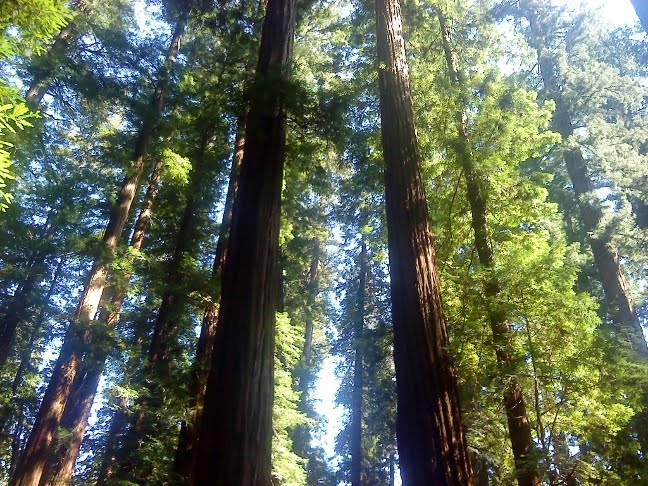
Photo from http://kymk.files.wordpress.com/2011/02/photo-op.jpg

Search This Blog

Showing posts with label Old Growth. Show all posts

Thursday, June 30, 2011

The Highway Expansion Would Significantly Harm One Hundred and Eight Old Growth Redwood Trees

Redwood Times Honors our Namesake http://www.redwoodtimes.com/ci_18321895

I appreciate this fact-filled article in Redwood Times addressing the concerns of those of us who treasure Richardson Grove and our unique Humboldt way of life. Gary Hughes and Barbara Kennedy presented Rotary new information on the likely irreparable impact to Richardson Grove, and questioned the value of this project for our community.

The new report by Dr. Joseph McBride -- forester, professor at UC Berkeley, author of 277 articles on trees (especially Redwoods) and adviser to State Parks -- offers the real science that CalTrans failed to give.

Dr. McBride’s tree-by-tree analysis of project impact on RG finds 108 old-growth trees that will have root systems significantly affected, and anticipates 37 are likely to die.

We cannot accept this likelihood of irreparable harm to our State Park, and the Redwood Curtain.

Thanks to Rotary and to Redwood Times for this good start to a fair hearing.

Lauren Oliver
****

Here is a link to Dr. McBride's Declaration
http://www.box.net/shared/djce84fkqklcmu10116s presented in the lawsuit against CalTrans brought by the Environmental Information Protection Center [EPIC], Center for Biological Diversity, Californians for Alternatives to Toxics [CATS], and individuals. The case is formally called:

BESS BAIR et al vs. STATE OF CALIFORNIA DEPARTMENT OF TRANSPORTATION
in
the U.S. District Court Northern District of California

Sunday, June 12, 2011

*New Handout* Brought to Bay Area & Sacramento

STOP HIGHWAY 101 EXPANSION THROUGH RICHARDSON GROVE!

Richardson Grove is the mystifying stretch of Highway 101 that curves through the south fork of the Eel River where, coming north, one first encounters ancient redwood forest. The California Department of Transportation (CalTrans) is set to implement a plan, launched by federal, state, and corporate interests, to widen Hwy 101 through Richardson Grove.
This project threatens the survival of ancient redwood forest and would usher in and exacerbate a host of
horrendous social, economic, and cultural problems.

Some of the last 2% remaining old growth redwoods, including the 9th tallest in the world, lives in Richardson Grove. It's crucial to do everything possible NOW in order to stop Caltrans. You know you're in redwood country when you bike, walk or drive through the road lined with giants of many generations. Further from the road, the redwood grove extends. You might notice the tops of some of the huge trees along Hwy 101. No greenery and no branches way up there, but instead “spike tops.” They're the result of top die-off from compaction & other injury to the shallow roots of the giant trees. Roots must be protected.

The Richardson Grove area, for millenia, has been & remains sacred territory for First Nations people in this region and is an important place for visitors and inhabitants, human & non-human, of many nations.

Traveling north up Hwy 101 from the Bay Area, you pass hillsides, stripped of their majestic oaklands, now replaced by miles of grape vineyard grids as far as the eye can see. North of that, you arrive in Willits, where there is an arched entry announcing “Gateway to the Redwoods”. But there are no redwoods there; only gas stations and chain stores lining a four lane highway.

As the redwoods in Willits have been replaced by roads and chain-stores, the current “gateway to the redwoods” is about 60 miles north:
Richardson Grove State Park.

CalTrans, using federal and state funds, plans to cut old and young trees, excavate ancient roots, and harm rare and endangered species that inhabit Richardson Grove- all to expand Hwy 101 for greater truck and military access through the coast. Richardson Grove State Park was established to protect this area from the “drums of progress." Not one tree should be cut or harmed in a State Park.

Ancient redwood forest is rare, highly threatened, near extinction. Ancient redwood trees: at risk of there being no more left on Earth. Roads, sprawl, development & short-sighted profiteers have, in a relatively brief period of time, stripped the earth of these amazing beings & the wisdom & life they support.

“There's a real NAFTA scam ruining lives all around.
Don't bring tanks and sweatshops through our ancient grounds.”
Richardson Grove Action Now

►CONTACT
RICHARDSON GROVE ACTION NOW


707.602.7551 rgroveactionnow@gmail.com

Direct Action to Stop the Road Widening!

Resist Corporate and U.S. Military Invasion

“I've seen great glaciers melting...met lightning eye to eye.
Now I hear bulldozers coming & I know that I am soon to die”
The Tree, Dana Lyons

***


CALTRANS PLANS TO EXPAND HIGHWAY 101
THROUGH RICHARDSON GROVE STATE PARK

● Funded by the Federal Govt. & the State of California, $5.5 million from each of them.


● A State Park is supposed to be protected from any tree cutting or damage. Tree cutting and irreparable damage are part of this plan.


● Ancient redwoods inhabit Richardson Grove. ● CalTrans would have to cut ancient redwoods in order to widen the road to the plan's dimensions.


● CalTrans would excavate and cut the roots of the ancient trees in Richardson Grove and severely compact the root zones.


● Redwood tree roots are shallow. They stay healthy through their connection to other redwood roots in the area, and cannot withstand compaction.


● CalTrans would be would stealing private property which includes old growth trees, is steeply sloped on both sides of the road, and houses Singing Trees (Drug) Recovery Center. ● That land would be stripped bare and flattened into roadbed for the road widening project.


● CalTrans also has plans to widen every highway coming from the East into the Humboldt Bay region. One of those plans would desecrate Jedediah Smith State Park on Rte 199. One plan has already included a huge clearcut on both sides of Rte 299, on the eastern end.


● Highway expansion through Richardson Grove is motivated by corporate, military, & nuclear industry interests.


● CalTrans tried to pass this plan through without environmental review or public input. ● There are 2 lawsuits with multiple plaintiffs against the plan.


● Politicians, from the County Supervisors to the Congress reps, rubber-stamped the plan, ignoring legalities and large public outcry.


● Local gov't used $55, 000 public funding to disingenuously promote the plan through paid letters to the editor, lobbying, & teaching business owners how to promote it.


● The State promotes the road widening to increase access for big trucks.


● There is a low incidence of accidents on Hwy 101 thru Richardson Grove currently -even though big semi's get through already.


THE ROAD WIDENING THROUGH RICHARDSON GROVE WOULD:

►bring an increase in large trucks going faster. Conditions would make the stretch dangerous for drivers and almost impossible for anyone to walk or bike on the shoulders as they do now.


►allow an inundation of trans-national corporations into north coast towns, subjecting the land, waters, forests, local economies, and working conditions to the ruinous dominance of greedy corporations.


►in conjunction with highway expansions from every other entrance into the Humboldt Bay region, expose the entire northcoast to increased militarization and corporate exploitation.


►have irreparable negative consequences. Change the face of the north coast.

THERE IS A STRONG PEOPLES' RESISTANCE TO HIGHWAY EXPANSION THROUGH RICHARDSON GROVE. WE NEED YOUR HELP!
Richardson Grove Action Now 707.602.7551 rgroveactionnow@gmail.com
saverichardsongrove.blogspot.com

Thursday, May 5, 2011

May 4, 2011 Lumberjack Article

Caltrans STAA Juggernaut Stalls at Richardson Grove

by Emma Nation

The Arcata-based Environmental Protection Information Center (EPIC) announced on April 20 that Caltrans agreed not to bid the Richardson Grove Improvement Project or otherwise move forward on their plan to widen Richardson Grove before July 1.

EPIC and a coalition of environmental groups and individuals filed a lawsuit against Caltrans for violations of the California Environmental Quality Act in the California Superior Court in San Francisco in May 2010, and the case was transferred to Eureka in November 2010.

“We are intent in seeing that the merits of our case are heard before Caltrans attempts to implement the project, and this development is an important step in achieving that objective,” said EPIC executive director Gary Graham Hughes.

Hughes cited “environmental democracy” as one reason for the legal case, stating that Caltrans has “largely ignored” complaints about the project from citizens throughout the county and state. The legal challenge is based on procedural grounds because, Hughes says, “It is the precise and correct facilitation of the environmental review process that guarantees democracy.”

The Surface Transportation Assistance Act (STAA), passed by Congress in 1982 and implemented in California the following year, set the maximum limit for trucks on the national highway system. The largest rigs include sleeper cabs which, when coupled with the largest legal trailer, puts the overall length of the truck over the California legal limit going through Richardson Grove.

Caltrans terms their Richardson Grove STAA-access project as “a long-standing transportation priority” for Humboldt County.

California law allows maximum-length STAA moving vans and cattle transports through Richardson Grove, and these vehicles pass through the grove daily.

David Spreen of Kneeland has been following the issue since 2007. He points out that the largest STAA rigs are not the industry standard, but routinely referred to as “industry standard” to create an argument for imperative road widening through Richardson Grove and on all major routes into the region. He says the largest STAA trucks are not appropriate for Humboldt County.

“If we’re going to become a de facto part of the national highway system, what are the overall implications of that for the county? They’ll put a lot of wear and tear on the county roads once they’re off the highway,” he said.

Spreen says Caltrans asserts that the improved access for the big rigs will not result in more trucks, just fewer loads in larger trucks.

“To my knowledge, there has never been a project allowing larger trucks to travel through an area that resulted in no increase in truck traffic,” he says.

In a letter to the North Coast Regional Water Quality Control Board, Spreen asked the agency to consider the cumulative watershed impacts of road building the same way it reviews the cumulative impacts of timber harvesting.

Spreen cites a November 17 article in the San Francisco Chronicle by Peter Fimrite, reporting that the U.S. Environmental Protection Agency warned Caltrans that its storm runoff management is inadequate throughout the state.

Fimrite quoted EPA enforcement officer Greg Gholson: “At any given construction site the problems may not have required enforcement, but taken as a whole the agency was very concerned with the deficiencies that were seen.”

The Chronicle article said EPA documents revealed storm water discharges of metals, sediment, oil, grease, pesticides and trash from numerous Caltrans construction sites along California’s 50,000 miles of highway and freeway.

Spreen urged Water Board members to deny Caltrans a permit and send the matter back to Water Board staff to conduct a cumulative impact analysis to be completed by December 31, 2011, after Caltrans releases its upgraded storm water management plan.

Luis Rivera, executive at the North Coast Regional Water Quality Control Board, said Caltrans' 401 water permit for the Richardson Grove project has been approved and sent to Sacramento for attorney review before it will be signed.

Although the agency is suing Caltrans for numerous 401 permit violations during the Confusion Hill Bypass Project (completed several years ago a few miles south of the Humboldt/Mendocino border), Rivera says the agency can’t deny a permit application based on Caltrans' past work performance because the water board has no power to effect reprisals for shoddy work. That matter would be up to the California Legislature, he said.

Answering concerns about excavating and severing old-growth redwood roots in the Richardson Grove plan, Caltrans says it won’t cut roots over two inches, and discounts environmental concerns that the work will harm the trees.

Caltrans states, however, that similar work on the Weott Four Bridges Project (in the planning phase) is “likely” to harm the old-growth redwood trees at that location.

The smallest, “hairy roots,” are the main water uptake organs for redwood trees.

Caltrans also states that it will work around the nesting season of the marbled murrelet in Richardson Grove, where potential nesting exists. However, the agency says in the Four Bridges project proposal that it can’t avoid working during marbled murrelet nesting season because it has to take advantage of the good weather.

Caltrans’ road widening project for Highway 199/197 may face similar problems to the Richardson Grove project, because the road through Jedediah Smith State Park also narrowly twists through old-growth forest.

The Middle of Buckhorn Project, a portion of Caltrans’ Highway 299’s proposed modification, has 17 curve improvements and is entirely earthwork—no bridges or major structures are in the plans—and could represent a major threat to the health of the Trinity River during construction and afterwards, as erosion often accompanies deforestation and mountain removal.

Chris Harvey, Caltrans District 2 Project Manager, calls the $11 million Middle of Buckhorn “a great project,” and says it’s funded by the agency’s safety program because of the accident history there.

Not everyone shares Harvey’s enthusiasm for the project, however.

Joseph Orozco, manager of tribal radio station KIDE-FM in Hoopa, and founder of the 7-Rivers Radio Network, says if Highway 299 and other roads were good enough to get the timber out of the region, they should be good enough for other exports. “If it wasn't for the roads, the logs wouldn't have gotten out of here,” he said.

Orozco says improving conditions for the big rigs would enable all traffic to go faster. He says Highway 96, which bisects Hoopa Valley, just off the 299, makes it difficult to develop the region's economy.

“People come in at a high speed and unconsciously go by at a high speed, making it unsafe for kids and others,” he said. “It's very easy to be in harm's way here.”

Orozco said fuel prices should be enough to discourage adopting transnational trucking as economic policy. “Keep the roads the way they are,” he advised. “They’ve been serving us for years. Keep commerce within your geographic area.”

In 2009 the Humboldt County Planning Commission disbursed grant money from the Headwaters Fund, which it oversees, to the Office of Economic Development to promote the Caltrans Richardson Grove Project to the public. The OED reportedly spent some of this money contracting a public relations firm to help prominent locals, including Caltrans executive Charles Fielder, write and edit six “My Word” columns in the Eureka Times-Standard, all promoting the Richardson Grove STAA project.
The OED supervises a branding scheme called Humboldt Made, and reportedly used some of the Headwaters grant money to produce a series of commercial videos featuring local products from the county's largest local exporters, including Sun Valley Floral, Lost Coast Brewery, and Cypress Grove Cheese.


These companies complain about the current cost of trucking their products out of the area, but critics of the STAA-access project say there is little evidence that their cost savings from using STAA trucks would translate into more jobs in the county.

Cypress Grove was bought last August by Emmi Holding Company, a Swiss conglomerate.

There have been 20 arrests for civil disobedience at recent demonstrations at Caltrans and before the Board of Supervisors.


Some say Humboldt County should develop sea and rail commercial routes because increased truck traffic sacrifices programs of economic sustainability and compromises the health of the region’s remaining natural resources.

Others say Humboldt County’s slow pace, quality of life, and natural beauty is what attracts tourists, some of whom see old growth redwood trees for the first time driving north on Highway 101 through Richardson Grove.

http://thelumberjack.org/news/caltrans-staa-juggernaut-stalls-richardson-grove

Wed, 2011-05-04

Wednesday, March 16, 2011

March 16 Update from Richardson Grove Action Now


On Wednesday, March 16, at 10 am, a group of us {activists involved with Richardson Grove Action Now} took a stroll and conducted a scouting mission up Highway 101 through Richardson Grove State Park and properties adjacent to the park. In addition to enjoying the immense beauty and serenity of the area, we made some observations and gained several insights that we would like to share with you.

Knowing that CalTrans has plans to replace and update the culverts (the pipe network that allows moving water to move from one side of the road to the other) on the southern end of the grove, we decided to take a close look at the culverts as they currently are. Since there was a good amount of rain earlier in the morning, the culverts, which are large pipes buried under the ground between the depths of 1-5 feet (I'd say) , were in full action with water being channeled under the road and crashing down the hillsides. A couple of us surveyed the culverts for a species of concern, a sort of rare salamander that could be endangered by this project. Though we did not find any trace of this elusive critter, we could not help but notice that some of the culverts run between thirty and forty yards (I'd say) into the state park. How is CalTrans planning to replace these culverts, some of which, as we mentioned, are a good five feet down in depth, without causing harm to nearby ancient redwood roots? The roots are also between one and five feet in depth.

Along the Richardson Grove stretch of Highway 101 we saw a number of CalTrans survey stakes, on the east side of the road, marked with a cryptic series of numbers and letters. We documented the stakes by photo and are now in the process of trying to make sense of these markers. There was speculation that some of these markers may be new (a week or so old), though this theory has not yet been confirmed. In any case, we were shocked by how close in proximity the stakes are in relation to massive, old growth redwoods. From what we understand, these stakes mark the borders of the CalTrans road widening project. If this is indeed true, and after looking at the Environmental Impact Report it seems to be, then CalTrans is planning to pave right up to many old growth trees. Given what we know about redwood root growth patterns, which are generally shallow and wide reaching, as well as modern road construction techniques, which effect the ground several feet below the pavement surface, this does not appear to bode well for the health and longevity of these living relics.

As we continued to head north and out of the state park area on our journey through the old growth forest, we observed, on a sharp curve on the west side of Highway 101 across from the Singing Trees Recovery Center about fifteen feet up on a steep slope, more brightly colored markers, similar to the markers that we saw earlier. If you were to picture the space in between the road and these markers filled with pavement (which if it were to be somewhat level would require the excavation

and removal of a hillside), the resulting image would be, comparatively to what is currently there, a section of road that is wider with a significantly less sharp curve. This is interesting, because CalTrans has insisted throughout the history of this project that their plan would not “straighten” the road but rather, as they claim, only marginally widen it in certain areas. If indeed it is part of CalTrans' plan to straighten the road in this section, the result would significantly reduce the aesthetic appeal of the north entrance to the park and moreover, add to its destruction.

Throughout our stroll and scouting mission, we could not help but notice that the electrical/telephone/cable lines are relatively short in height in the Richardson Grove section when compared to the lines on rest of Highway 101. In fact, by our estimation, some of the lines offer only a mere foot and a half of clearance for the tops of the larger trucks passing underneath them. It seems logical then to assume, since CalTrans has stated that its reason for "improving" this section of road is to allow greater access to larger trucks (although it is illegal to do any sort of construction in a state park for the purpose of perceived economic gain) that these lines will also be "improved". This seems especially likely because some of the poles that support the weight of these lines are in areas that are designated to be paved over. Given this, it seems to us, although we are not really sure, that PG&E., AT&T, Sudden Link, and possibly other line owners must also be scheduling work in the Richardson Grove area in the near future.

Constant research and information is vitally important for us in our fight to stop CalTrans' plan to widen Highway 101 through Richardson Grove. Although today's stroll through the proposed project area provided us with a more clear view of what is happening on the ground, there is still MUCH that we want to understand about the on-ground, day-to-day logistics. There is no injunction (stop order) from the courts to halt the construction project to widen Highway 101 through Richardson Grove. CalTrans has already begun the preliminary steps (surveys, permit acquisitions, contractor bids, etc.) to begin the on-the-ground work. We do not know the exact date that construction will begin but we do know that it is likely to occur in the near future. The time is now to stop this, the time is urgent, we must act!

Note: In December 2010, CalTrans made representations to the court and to the entities suing to stop the plan through Richardson Grove, that work on the project would not begin until at least June 2011. However, CalTrans has been preparing for the road widening. On the CalTrans website, culvert and other work are officially posted to begin this month, March 2011. Feel free to ask CalTrans employees yourself (at the office or on the ground) what they are doing!


Friday, March 11, 2011

RALLY date changed to Friday April 1st due to weather. No joke :)


UPDATE! RALLY RESCHEDULED FOR APRIL 1ST DUE TO WEATHER. SEE YOU THERE!

Friends of Richardson Grove Will Hold A Rally & Celebration of Spring On Friday April 1st, 2011 Challenging the Highway Widening Project Threatening Ancient Humboldt County Redwoods


CalTrans Project Through Richardson Grove State Park Would Harm Old-growth Trees, Marbled Murrelet Habitat, and Rural North Coast Towns


GARBERVILLE, Calif.— A group of Friends of Richardson Grove State Park invite the public to a Rally and Celebration of Spring on Friday, April 1st, 2011 from 12:00 Noon until 4:00 PM at the Garberville Town Square. This will be a family-friendly event focusing on educating the public about the ill-advised highway-widening project that not only threatens the ancient redwoods of Richardson Grove State Park, but could also change the rural character of Humboldt County.


The event will feature local speakers, musicians including Bud Rogers, Jefferson Parsons and Defenders of the Holy Grove, educational literature, sample letters to send to elected representatives, a craft table for children and adults and the opportunity to discuss with neighbors the effects this project might have on our State Park and Community.


The highway project is widely opposed by local residents, business owners, conservation and Native American groups, and economists as unnecessary and damaging to the State Park, the venerable old-growth grove and its wildlife, tourism, and the coastal communities of Humboldt County.


Caltrans and certain business interests have attempted for decades to provide access for larger commercial trucks through the area, and in the past few years have pushed for widening the narrow, meandering section of Highway 101 through the world-renowned ancient redwood grove in Richardson Grove State Park. This park at the southern entrance to Humboldt County is considered to be the “redwood curtain” protecting the small communities of the north coast from blight and urban development. Public outcry has so far protected the grove from development, but Caltrans and a handful of business interests have aggressively pushed for access for larger trucks.


Established in 1922, Richardson Grove State Park was recently rated as one of the top 100 state parks in the United States, and attracts thousands of visitors from around the world every year to explore one of the last protected stands of accessible old-growth redwoods. It is here you first encounter significant old-growth forest when driving north, and this popular tourist destination has provided many people with a transformative experience walking through some of the oldest living beings on the planet.


The proposed spoiling of Richardson Grove and widening of the highway through the “Richardson Grove Operational Improvement Project” does not serve the region’s best interests and threatens the area’s environment, economy, and way of life. The Humboldt County Economic Development Program has used public funding for a misleading public-relations campaign claiming the widening and increased large-truck traffic are needed for safety and commerce and will benefit Humboldt County through falling retail prices, bolstering the local economy, and making travel into the county from the south safer. Bigger trucks do not somehow translate to consumer savings, but do increase wear and tear on roadways and decrease safety for smaller vehicles. The widening would provide incentive for big-box retailers like Walmart and Home Depot to move into Humboldt County, to the detriment of local businesses. The reality is that this project has the potential to change forever a rural lifestyle cherished by residents of the North Coast.


Caltrans claims the “realignment” project is needed to safely accommodate large-truck travel, remove the restriction of larger vehicles on this section of highway, and improve movement of commercial goods. However, it appears from Caltrans’ own statements and signage that the portion of road for which this project is contemplated is currently designated for larger trucks and that Caltrans has exaggerated potential safety problems.


Advocates for the grove forced the agency to complete a full Environmental Impact Report, rather than the Categorical Exemption and minimal environmental analysis Caltrans originally tried to employ. Caltrans’ preferred project appears to be a predetermined decision taken in advance of the environmental analysis. Federal law prohibits transportation projects on public-park lands except in cases where there is no feasible alternative. Since smaller-sized commercial trucks already travel through the grove to deliver goods to Humboldt County, one feasible alternative would be to leave the highway as it is and retain the integrity of Richardson Grove.


The project is opposed by the Environmental Protection Information Center, Save Richardson Grove Coalition, North Coast Environmental Center, InterTribal Sinkyone Wilderness Council, Friends of the Eel River, Center for Biological Diversity, Bay Area Coalition for Headwaters, Californians for Alternatives to Toxics and Richardson Grove Action Now, among others.